“Greenwashing” in Sammamish: A Special Report

  1. Greenwashing (a compound word modeled on “whitewash”), or “green sheen,” is a form of spin in which green PR or green marketing is deceptively used to promote the perception that an organization’s products, aims or policies are environmentally friendly.–Wikipedia.

Since the 2003 Sammamish City Council election, in which environmental-leaning candidates swept the election, the Council prided itself on pursuing “green” policies and ordinances.

The City Manager was far less gun-ho, often lagging his own staff, especially when it came to a concept called Low Impact Development, or LID (not to be confused with Local Improvement Districts, also LID, a special tax option–so context of “LID” is always important to understand).

The current Council is comprised of what would ordinarily considered to be environmentalists. Of the seven, only Member Don Gerend leans “development” over the environment–or so its appears. Tom Odell and Bob Keller proved to have strong environmental credentials. Ramiro Valderrama evolved into a strong backing of the environment. Deputy Mayor Kathy Huckabay and Mayor Tom Vance not only consider themselves environmentalists but have an historical track record supporting this.
Image via Google Images. Click on image to enlarge.

Without question the leading environmentalist on the Council is three-term incumbent Nancy Whitten, who decided to retire at the end of this year. And Whitten has been increasingly critical of the collective Council’s direction on a number of environmental issues over the past four years.

While “greenwashing” isn’t the term that comes to the top of the conversation with Whitten, she didn’t disagree with its use when it comes to how Sammamish approaches the environment now. And she’s especially critical of Vance’s evolution away from his historical green leanings.

Continue reading

Kokanee savior targets next step: Zaccuse Creek restoration

Sammamish’s leading savior of the threatened kokanee salmon, the only salmon native to Lake Sammamish, is taking the next step to save the species: the restoration of Zaccuse Creek.

Wally Pereyra, who spent hundreds of thousands of dollars to restore Ebright Creek to help save Kokanee salmon, is moving on to Zaccuse Creek as the next phase of his decades-long effort. the Kokanee are native to Lake Sammamish. Photo via Google image. Click on image to enlarge.

Wally Pereyra, who already spent hundreds of thousands of dollars of his own money to restore Ebright Creek and to appeal City of Sammamish approvals of upstream development he believes would harm Ebright Creek, is preparing to restore Zaccuse Creek in cooperation with the local Snoqualmie Tribe and, he hopes, the City.

Planning began several years ago. A June 2012 study with King County surveyed the creek, a culvert that goes underneath East Lake Sammamish Parkway and upstream and downstream from Pereya’s property. The study has several photos illustrating the 25 page report.

Pereyra owns several large parcels of land south of Thompson Hill Road, continuously along the Parkway to his residence.

Continue reading

City blocks environmental report in land use appeal

  • Appellants planned to use report in Conner-Jarvis case.
  • Conflict of interest with City contract cited.
  • Same environmental consultant allowed for applicant in Chestnut Estates West case.
  • Conner-Jarvis appellant charged City would withdraw traffic mitigation plans if project appealed.
  • Similar neighborhood traffic concerns to Chestnut appeal, which the City lost.
  • Links to download documents are toward the bottom of this post.

The Sammamish City Manager blocked an environmental consulting company from being a witness at a land use appeal of the Conner-Jarvis development, and with it, the report the company prepared, charges Mike Grady of the appellant, the Kempton Downs Community Organization.

Grady charged that City Manager Ben Yacizi invoked a clause in the consultant’s City contract for services unrelated to the appeal that says the firm, The Watershed Company, can’t undertake work that in conflict with the City.

Watershed was allowed to be a consultant and expert witness on behalf of the William Buchan Co. in the Chestnut Estates West application, says Grady. The City’s Hearing Examiner threw out the application, handing a victory to the appellants. Buchan told the Sammamish Reporter it plans to appeal the decision this month.

Wetlands weren’t properly assessed, Watershed says

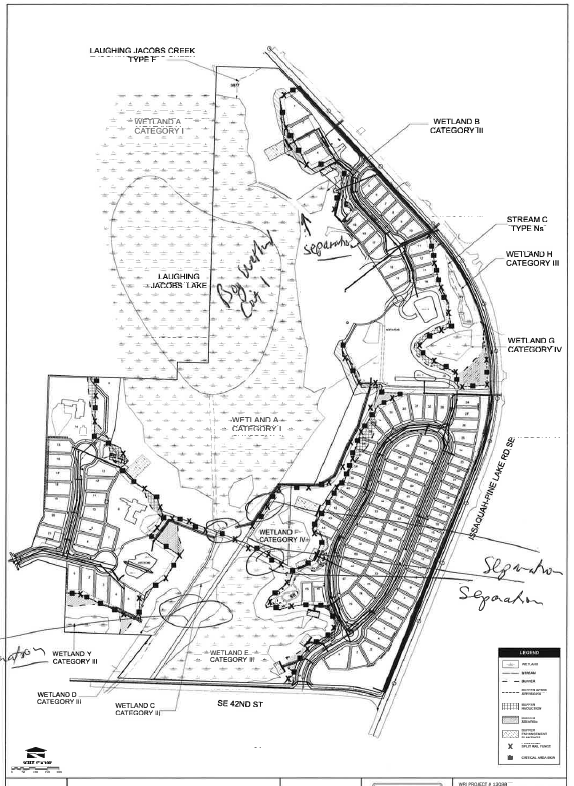
Conner Jarvis Layout 072015

The layout of the proposed Conner-Jarvis development of 115 single family homes on 40+ acres. Click on image to enlarge. The handwritten notes are from the person who supplied this rendering to Sammamish Comment.

Sammamish Comment obtained a copy of the Watershed report in the Conner-Jarvis case. The report concluded:

  • that the wetland boundaries were misidentified by Conner’s consultant;
  • the potential effects of the “water flow processes” that sustain Laughing Jabos Creek and the wetland ecosystem were not adequately characterized; and
  • the wetland complex should be rated as a single unit rather than separate wetlands.

Some of the issues between Chestnut and Conner are similar: the threat to kokanee salmon from upstream runoff. Kokanee are native to Lake Sammamish and to three creeks: Ebright Creek, which was the relevant creek in the Chestnut case and about half way up the lake; Lewis Creek at the far south end of the lake; and Laughing Jacobs Creek, which is relevant in the Conner case, which is in between Lewis and Ebright.

Hearing Examiner John Galt held a session Monday morning whether to admit the report despite the City’s exclusion. Galt denied a request to enter the report into the record, but gave the appellant until Oct. 28 to come up with a new report.

Continue reading