
PDC rejects Odell complaint against Shedd, Citizens for Sammamish

City Council Member Tom Odell filed a complaint with the State Public Disclosure Commission against Harry Shedd and Citizens for Sammamish.

The Washington State Public Disclosure Commission has rejected a complaint filed by Sammamish City Council Member Tom Odell with the State Public Disclosure Commission against Harry Shedd and Citizens for Sammamish (CFS).

Odell filed the complaint under his own name and not as a City Council Member when campaign “yard” signs and newspaper advertisements began appearing in the City supporting an affirmative vote for Initiative and Referendum (I&R) for Sammamish voters.

Odell vehemently opposed adoption of the I&R and was the lone vote against even putting the issue to voters in an Advisory Ballot in the April 28 election.

Harry Shedd, cleared by the Public Disclosure Commission of Tom Odell’s complaint.

Odell complained to the PDC that Shedd or CFS failed to file financial disclosures with the PDC.

Odell’s complaint was part of a secret campaign by the City, led by Deputy Mayor Kathy Huckabay, to undermine the vote, public meetings by CFS and sow confusion among voters.

Continue reading

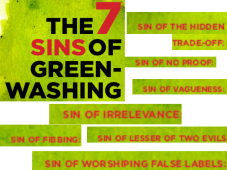
“Greenwashing” in Sammamish: A Special Report

  1. Greenwashing (a compound word modeled on “whitewash”), or “green sheen,” is a form of spin in which green PR or green marketing is deceptively used to promote the perception that an organization’s products, aims or policies are environmentally friendly.–Wikipedia.

Since the 2003 Sammamish City Council election, in which environmental-leaning candidates swept the election, the Council prided itself on pursuing “green” policies and ordinances.

The City Manager was far less gun-ho, often lagging his own staff, especially when it came to a concept called Low Impact Development, or LID (not to be confused with Local Improvement Districts, also LID, a special tax option–so context of “LID” is always important to understand).

The current Council is comprised of what would ordinarily considered to be environmentalists. Of the seven, only Member Don Gerend leans “development” over the environment–or so its appears. Tom Odell and Bob Keller proved to have strong environmental credentials. Ramiro Valderrama evolved into a strong backing of the environment. Deputy Mayor Kathy Huckabay and Mayor Tom Vance not only consider themselves environmentalists but have an historical track record supporting this.

Image via Google Images. Click on image to enlarge.

Without question the leading environmentalist on the Council is three-term incumbent Nancy Whitten, who decided to retire at the end of this year. And Whitten has been increasingly critical of the collective Council’s direction on a number of environmental issues over the past four years.

While “greenwashing” isn’t the term that comes to the top of the conversation with Whitten, she didn’t disagree with its use when it comes to how Sammamish approaches the environment now. And she’s especially critical of Vance’s evolution away from his historical green leanings.

Continue reading

Sammamish needs to open up with transparency on TIP; there’s a “now you see it, now you don’t” show happening

Illustration via Google images.

Sammamish officials have a serious transparency and credibility problem.

The side-by-side comparison of the 2014 and 2016 Six Year Transportation Improvement Plans (TIPs) shows what appears to be creative “book keeping” to present a financial picture that is rosy when it’s really not. Sammamish Comment also reviewed prior TIPs to compare projects and projected costs.

Sammamish Comment spent this week dissecting the TIPs for the Readers. The issues are these:

Continue reading

City shifts $23m from City Roads to Klahanie project–but had vowed not to affect legacy Sammamish

When Sammamish officials in the summer of 2014 lopped around $19m off its 2015 Six Year Transportation Improvement Plan from four long-standing road projects, they had already pledged to improve and widen Issaquah-Fall City Road along the entire length of the east side of the Klahanie Potential Annexation Area if voters there agreed to annex to Sammamish.

Klahanie PAA voters rejected a plan the previous January to annex to Issaquah. Sammamish, which campaigned against the Issaquah vote, promised to take on the road project if a subsequent vote to annex to Sammamish was held and approved. King County at one time placed a price tag of $32m on the project. Sammamish officials studied the plan and concluded King County had double-counted some of the work in a two-phase plan and estimated the cost was closer to $23m.

For several consecutive TIPs, costs for four key projects within Sammamish remained constant. Facing the Klahanie project, the 2015 TIP cut$19m from these projects. Another $3.6m was further reduced from the 2015 TIP for the 2016 TIP, approved last month.

The analysis that revealed City officials shifted $22.5m from road projects to fund the $23m Issaquah-Fall City road widening to fulfill a commitment for the Klahanie area annexation appears to go back on a pledge to Sammamish residents that they wouldn’t be impacted by the annexation.

It also appears to be an effort to mask early statements by City officials that Sammamish would have to issue $23m in bond debt to pay for the Issaquah-Fall City/Klahanie road widening project.

Continue reading

Transparency (or the lack of it), the evolving Sammamish City Newsletter and taxpayer dollars

The August Sammamish City Newsletter contained a front page article about the state of the City’s finances and the Six Year Transportation Improvement Program (TIP).

This was followed on the next page by the Mayor’s Message, in this case from Tom Vance, who is in his second year as mayor.

The articles are clearly responses to public questions about the TIP funding and proposed City expenditures in the hundreds of millions of dollars over the next six years for a variety of projects, notably from Council Member Ramiro Valderrama. He’s repeatedly questioned the financial viability of the road projects and how these will be funded.

This column also questioned the TIP and its ending fund balance as adopted, showing a near-depletion by 2020.

The article is a clear response to Valderrama and to The Sammamish Comment. The Mayor’s Message is a clear puff piece, transparently touting policies and promotions as Vance heads into a reelection campaign that will get underway after Labor Day.

The City Newsletter has transformed from a means to inform citizens to a propaganda piece to refute questions raised by members of the City Council and the Public and, in the case of the Mayor, to defend his own practices from criticism.

Continue reading