Sammamish disaster planning “not enough,” says City Manager

June 23, 2016: Sammamish participation in the Cascadia Rising earthquake drill this month was labeled a success, but City Manager Lyman Howard acknowledged the level and scope of participation wasn’t enough.

Lyman made his remarks in an interview last week with Sammamish Comment.

Sammamish wasn’t going to participate at all until The Comment began making inquiries last fall about failure to sign up for the multi-state, multi-jurisdictional, international drill. The drill, assuming an earthquake from then Cascadia fault line off the West Coast, encompassed British Columbia to Northern California.

The drill’s parameters assumed Sammamish telephone and cell phone communications were disrupted and damage on major arterials leading in and out of the City occurred.

Howard told The Comment that Sammamish focused on its inter-agency and emergency communications with local citizen groups, such as the Info Hubs operated by the Sammamish Citizen Corp and CERTs; and Sammamish Plateau Water. City Hall was evacuated. But links to the County and State weren’t tested, nor were there actual drills in the City.

“It’s not enough [what the City did], I’ll be honest,” Howard said. “We’re talking with CERT about annual drills.”

Continue reading

Sammamish Retreat analysis

The Sammamish City Council’s 2016 Retreat wrapped up Saturday. Here are thoughts and analysis:

  •  Retreat location: This was the first time in about 10 years Sammamish held its Retreat on this side of the Cascade Mountains. Given how often Snoqualmie Pass closed this season (including City_of_Sammamishtwice on Saturday alone), holding it in Tacoma was good from this perspective alone. Council members and the Administration liked the remote location because it discouraged public participation and afforded total candor–sometimes to the point of open warfare (as occurred last year, despite presence by Sammamish Comment and others). In Tacoma, The Comment and others were present all three days, with the public attendance of almost a dozen on Saturday. The sky didn’t fall in. The atmosphere was far more civil this year as well (see below).

Continue reading

Sammamish Council Retreat: Legislative Priorities and other things

Jan. 14, 2016: The Sammamish City Council outlined its priorities for the State Legislature at the first part of its annual Retreat today. The Retreat began at 5pm and continues to noon Saturday.

Among the issues Sammamish supports:

Continue reading

Blustery weather adds realism to Info Hub exercise

Saturday was a blustery, rainy and generally miserable day.

It wasn’t conducive to getting a lot of citizens to outdoor events but it many ways it was perfect for the Sammamish Citizens Corp. to hold its Info Hub exercise. There were reports of power outages. Trees limbs and debris came down throughout the City. On 212th Ave. SE between SE 29th and SE 33rd streets, a limb came down on power lines, severing one and landing on two or three, causing shorts and a small fire at the out-of-reach power lines where the limb crossed the lines. The Eastside Fire & Rescue and the Sammamish Police blocked off the southbound lane of 212th through the area.

Continue reading

Disaster exercise Saturday, Oct. 31: Info Hubs

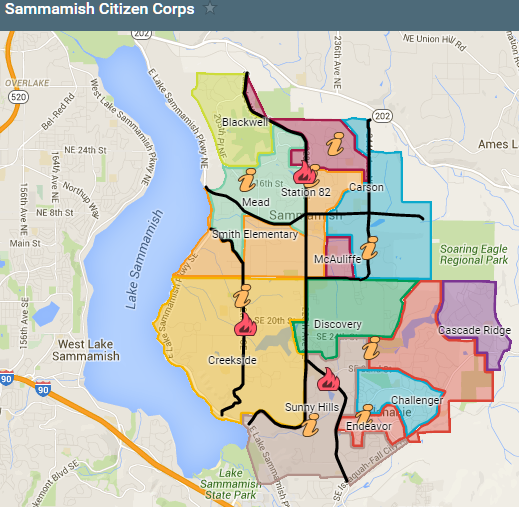
InfoHub Locations

Info Hub locations in Sammamish. Click on image to enlarge.

There will be a disaster drill exercise Saturday, Oct. 31, in Sammamish for residents of the City call Info Hub. Hours are from 9am to 1pm. Since it is Halloween, children showing up with parents will receive a prize.

This is a “drop-in” event, not something for which residents have to plan a four hour commitment.

The Sammamish Citizens Corp. (SCC), a volunteer group that is affiliated with the Department of Homeland Security, is the organizer. The City of Sammamish will also participate.

“In the event of Catastrophic Disaster, the Citizens of Sammamish need to be able to be on their own for 3-10 days,” says the SCC.  “Part of recovery is to reunite family members and to share resources within the community.  By creating a meeting place accessible to a larger population and sharing that information, neighbors will have a place to go to give and get information and resources.  Each Info Hub will need communicators.   By using the Elementary School boundaries, we can divide the plateau into 11 zones and locate the Info Hubs at a public/private Park within that zone.  There can be multiple Info Hubs within the boundary of an elementary school.”

Continue reading