Issaquah stonewalls Klahanie on water at annexation meeting

Representatives of Issaquah refused to answer any questions at the city-sponsored informational meeting for the potential annexation of Klahanie about plans to inject polluted stormwater into a well that could contaminate the aquifer providing drinking water for Klahanie.

There was a public meeting last night, May 22. They were asked over and over and over to comment on the water issues; they refused every time.

[The Sammamish City Council raises questions over Issaquah’s plans.]

So much for Issaquah Mayor Ava Frisinger’s pledge of being “open and transparent” on the water permit issue.

Several Klahanie residents asked the representatives of the city about Issaquah’s plans to inject water into the so-called LRIG, the Lower Reid Infiltration Galley. The aquifer provides water to Well 9 owned by the Sammamish Plateau Water and Sewer District, and in 2009 the state Department of Ecology closed the LRIG because fecal coliform (bird and other poop) infiltrated through the LRIG and contaminated the aquifer.

Issaquah on May 8 told another Klahanie-focus meeting that there will be no change in what agency supplies the water, but this omitted the fact that the city is already engaged in a hostile takeover attempt of the Water District.

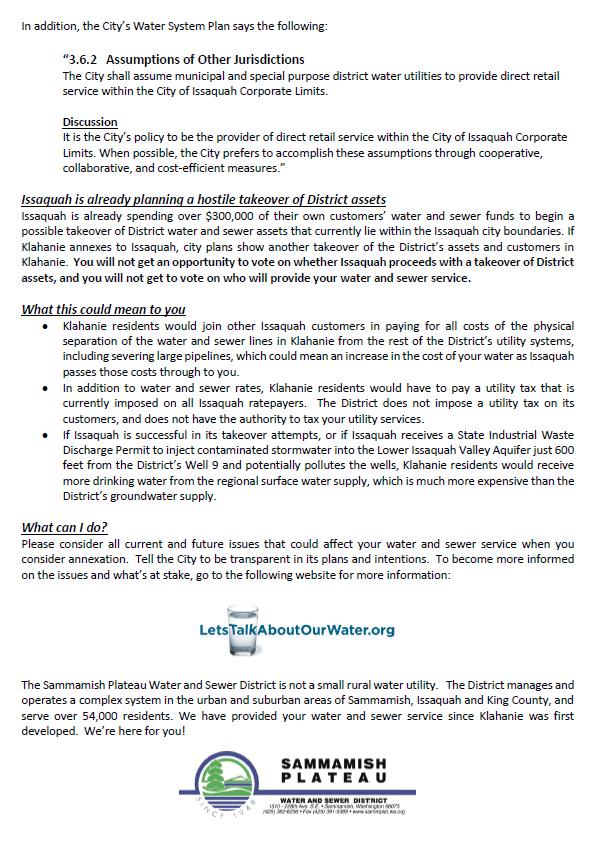
Here is a Fact Sheet the Water District issued (click on images to enlarge):
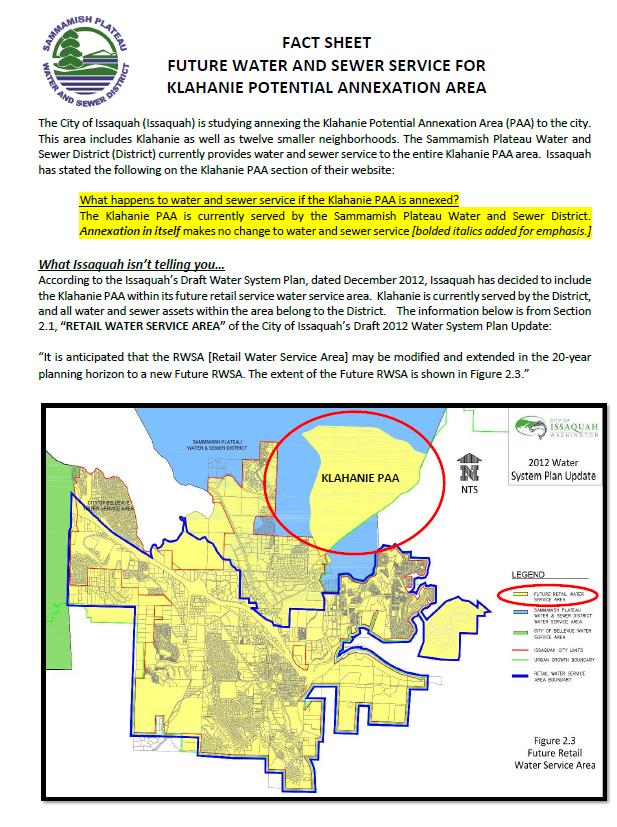
Klahanie Fact Sheet Pg 1

.

Klahanie Fact Sheet Pg 2

Become a Party of Interest in the Issaquah/Ecology permit application

I have learned from the Department of Ecology that it intends to issue its Draft Permit to Issaquah for the right to inject storm water into the so-called LRIG by the end of June. There will be a 30 day comment period from then.

I’ve written several posts expressing grave concern over Issaquah’s plan and Ecology’s intention to allow this. The Lower Reid Infiltration Galley, or LRIG, over an aquifer from which the Sammamish Plateau Water and Sewer District draws water that serves parts of Issaquah, all of Klahanie and parts of unincorporated King County, and three quarters of our city, Sammamish (basically all but the far north end).

Tests have shown in the past high concentrations of fecal coliform (bird and other poop) penetrated past the LRIG and infiltrated into the aquifer. Ecology shut down the LRIG infiltration in 2009 but is prepared to let Issaquah resume this shortly.

It’s important that citizens of Sammamish (and of Klahanie and all areas, for that matter, including Providence Point and Overdale in Issaquah) weigh in on this permit.

By becoming a Party of Interest, you will be notified when the Draft Permit is issued and will therefore be able to comment as part of the official record.

To become a Party of Interest, email Cheryl Thompson at Ecology at chth461@ecy.wa.gov

Check out my previous posts for more information on these issues.

Gerend wants Klahanie; Issaquah to meet with Klahanie May 22

Don Gerend declared once again that as a Sammamish City Council member, he wants to see Klahanie annex to Sammamish instead of Issaquah.

The area with 10,000 residents and a shopping center is, of course, in the Issaquah Potential Annexation Area. Issaquah officials met May 8 with a small group of residents at the Issaquah City Hall and has a meeting scheduled May 22 at Challenger Elementary School, 25200 SE Klahanie Blvd. at 7 p.m. to discuss possible annexation into Issaquah.

Gerend made the comment to a resident who lives in an unincorporated area between Klahanie and Sammamish and who doesn’t want to be part of Issaquah. The area is also in Issaquah’s PAA. The resident asked Sammamish to become involved, which can only be done if the areas are struck from the Issaquah PAA.

Gerend said that for 14 years (his entire time on the Sammamish City Council) he’s wanted to annex Klahanie.

A complicating issue has emerged over annexing Klahanie, however: this is Issaquah’s permit application the State Department of Ecology to inject stormwater into the aquifer from which Klahanie gets its drinking water and plans to effect a hostile takeover of part of the Sammamish Plateau Water and Sewer District that draws its water from that aquifer.

Issaquah also eventually wants to assume the part of the Water District that Klahanie falls within, even though as recently as May 8 the city said nothing would change on this point, failing to reveal its true intentions.

I wrote about this deliberately misleading action on the part of Issaquah previously.

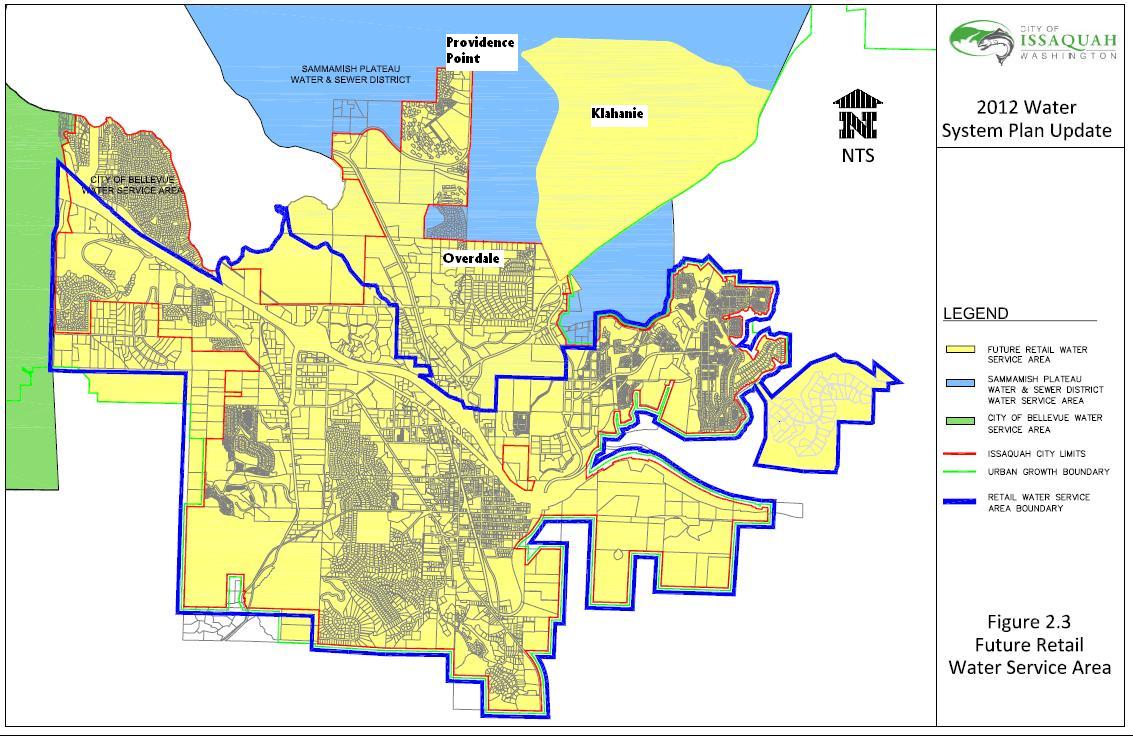
(Click on the illustration to enlarge.)

Klahanie SPWSD page

.

Clearly, Issaquah has some explaining to do with Klahanie, starting with why on May 8 it told Klahanie residents nothing would change about who provides water service to the area when plans have been underway for a long time to seek a hostile takeover of parts of the SPWSD, including the Klahanie area.

Then there are questions about the water quality protection of the aquifer that serves Klahanie. Although Issaquah claims its plan will be safe, the SPWSD has a different view. Klahanie residents might want to ask Issaquah and the Water District about this.

I have written several posts on this water topic. There are several links within the following to other stories by media. Here is a report from the Issaquah Press.

“We all drink from the same glass”

Issaquah takes the cheap route-except it doesn’t

Issaquah plan threatens Sammamish, Klahanie water supply

Issaquah doesn’t tell Klahanie: We’re pursuing hostile takeover of Water District

Issaquah held an informational meeting May 8 about the potential annexation of Klahanie, an area of nearly 11,000 residents, and omitted a key piece of information: the city is pursuing a hostile take-over of the Sammamish Plateau Water and Sewer District, the provider of their water service.

Nor did the city tell Klahanie residents that it is pursuing a permit with the state Department of Ecology that will inject stormwater into the aquifer that supplies drinking water to Klahanie.

So much for being open and transparent.

[Issaquah plan threatens Klahanie water supply.]

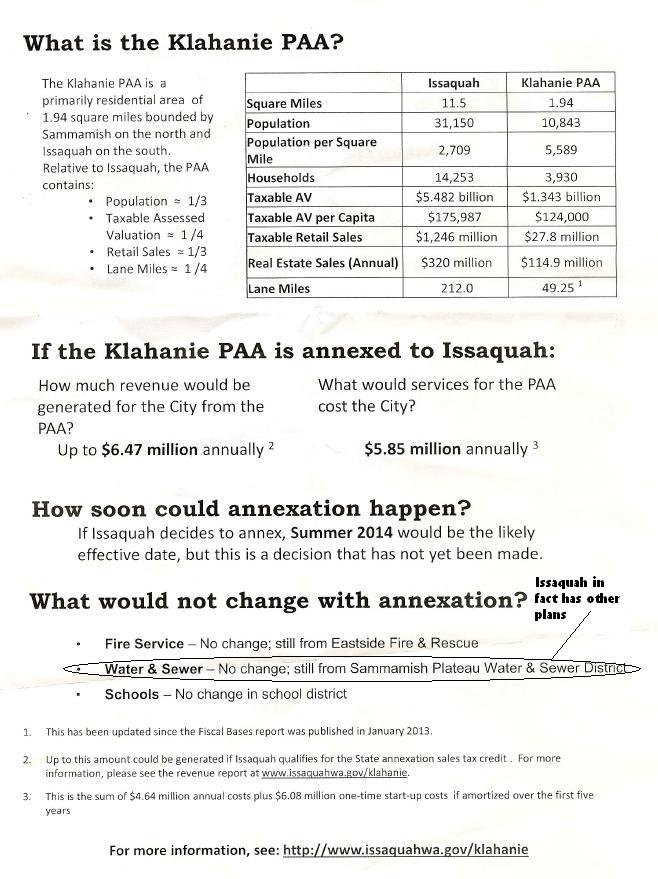
In a handout Wednesday night, Issaquah wrote:

What would not change with annexation

  • Water & Sewer: No change; still from Sammamish Plateau Water & Sewer District

In this flyer, Issaquah says it does not have plans to provide water and sewer service to Klahanie. What the city is not saying is that it does have plans to include Klahanie in its future utility service. In Issaquah’s own 2012 Comp Plan, the city clearly shows Klahanie inside the “Future Retail Service Area” (Figure 2.0x).

IssWaterTakeover

Why does this matter? Keep reading below the jump.

Continue reading

“We all drink from the same glass of water:” Mayor Frisinger in defending plan that threatens Issaquah, Sammamish and Klahanie water supplies

That’s what she said May 6 to media and on Social Media.

““We all drink from the same glass, the citizens of Issaquah and Sammamish,” Issaquah Mayor Ava Frisinger said.” Press release dated May 6, 2013, on Issaquah City website.

What if that glass of water looks like this?

Issaquah’s plan to inject stormwater runoff without adequate pre-treatment proposed by the Sammamish Plateau Water and Sewer District–threatening our drinking water aquifer that is immediately below the so-called LRIG into which the Mayor wants to inject stormwater–may not look this bad but it’s what you don’t see that will hurt you.

Fecal coliform (from bird and other animal poop), metal particles and contaminants contained in stormwater runoff from Issaquah Highlands are all in stormwater. Issaquah contends filtering it through the ground and the LRIG will be adequate. The Water District says more pre-treatment is needed. This is the crux of the battle going on between the city, the District and the Washington Department of Ecology right now. Ecology, inexplicably, is nearing approval of a Draft Permit to allow Issaquah to inject stormwater into the ground only nine feet from the District’s aquifer that serves 54,000 people mostly in Sammamish and Klahanie and including other portions of unincorporated King County and parts of Issaquah.

The Water District offered three times to co-fund a pre-treatment facility and Issaquah rejected each offer.

Frisinger says Issaquah is committed to protecting the aquifer. If this is true, you have to ask: why won’t the city work together with the Water District, which offers to co-fund a proper pre-treatment stormwater facility?