Klahanie area annex to Issaquah too close to call: Yes leads by six votes on election night

Residents of the Klahanie Potential Annexation Area are evenly split whether to annex to Issaquah; the Yes vote leads by only six votes on election night, making the election too close to call and creates the possibility of a recount.

For Annexation: 1,168, or 50.13%

Against Annexation: 1,162, or 49.87%

Based on my history of participating in elections from 1998-2011 in campaigns and watching voting trends, election night results haven’t varied by more than 1% from the final results, posted about two weeks later. This vote will likely be too close to call for days to come and may require a recount.

The vote is a cliff-hanger for Issaquah and the City of Sammamish. Issaquah is counting on the annexation to give it greater bonding indebtedness and to spread its current debt across the PAA. Issaquah was damaged in its fight with the Sammamish Plateau Water and Sewer District, when public documents and a highly public dispute revealed Issaquah’s government wanted to inject storm water into a treatment area near a drinking aquifer that the District believed would be inadequately filtered. Issaquah was caught cyber-squatting the District’s websites. Further, Issaquah’s history of demonstrating it couldn’t be trusted with respect to Klahanie was revealed, including a signed Memorandum of Understanding signed by the Issaquah Mayor to turn over the PAA to Sammamish, only to renege a short time later.

For Sammamish, the City Council salivates over the prospect of annexing Klahanie and City Council members campaigned actively to kill the annexation.

Sammamish city officials promised the 10,000-resident Klahanie area tens of millions of dollars in road and parks improvements and pledges of a more sensitive and representative government, better police protection and other services.

On the surface, Sammamish may have had the better case. But hardball tactics threatening to close the fire station 82, more commonly known as the Klahanie fire station, during its bitter negotiations with the Eastide Fire and Rescue District, and a ham-handed last minute effort in the State Legislature to deny annexation transition funds to Issaquah, offended PAA residents. The outcome of the election may well hinge on this last minute tactic and how last minute voters react to it.

Sammamish Councilman Don Gerend objected to our post over the weekend that included a report that four Sammamish city council members were doorbelling in Klahanie against the annexation; he says only one was doorbelling, which is contrary to what we were told by another city council member.

Gerend, a member of the Klahanie Choice anti-annexation group, also objected to our criticism of the city’s tactic supporting a bill in the Legislature seeking to deny funding to Issaquah to ease the transition of the annexation. The Seattle Times has this story, noting that Gerend and Sammamish Mayor Tom Vance testified in favor of the bill.

The Vance-Gerend testimony, and Sammamish’s hand in the bill, will no doubt futher sour already testy relations with Issaquah, and it is an inauspicious start to Vance’s term as mayor.

The King County Elections division will update voting daily in the late afternoon. Election results are scheduled to be certified February 25 if a recount proves unneeded.

Sammamish City engages in underhanded tactic over Klahanie

The City of Sammamish, which wants the proposed annexation of the Klahanie Potential Annexation Area by Issaquah, defeated in Tuesday’s vote (Feb. 11), engaged in an underhanded tactic aimed at only the Klahanie vote–a discriminatory effort that I wonder whether it would even survive a legal challenge.

The Sammamish Review article linked above gives the details, but in a nutshell, under state law, cities get a sales tax adjustment when they annex unincorporated areas. This helps the transition of the additional cost to a city of providing services to the area that was previously supported by county taxes. The City of Sammamish succeeded in getting a bill introduced in the State Senate to block this for Issaquah.

The Sammamish Review was right when it said this is sickening. It’s also hypocritical. The new City of Sammamish benefited from the sales tax revenue sharing after incorporation in 1999. The purported excuse that this bill from State Sen. Andy Hill is a state budget-saving measure doesn’t pass the laugh test. If this were a sincere budget effort, the bill should apply statewide and not just to Klahanie. The discriminatory effect is apparent for all to see.

Continue reading

Should Sammamish have city council “districts”?

Seattle has gone to City Council Districts, plus two at-large seats, in its most recent election. The theory is to provide greater representation for the areas of the city.

The concept was floated early in Sammamish’s history, though it didn’t go anywhere. When Sammamish was incorporated, all seven City Council seats were at large and this remains so to this day.

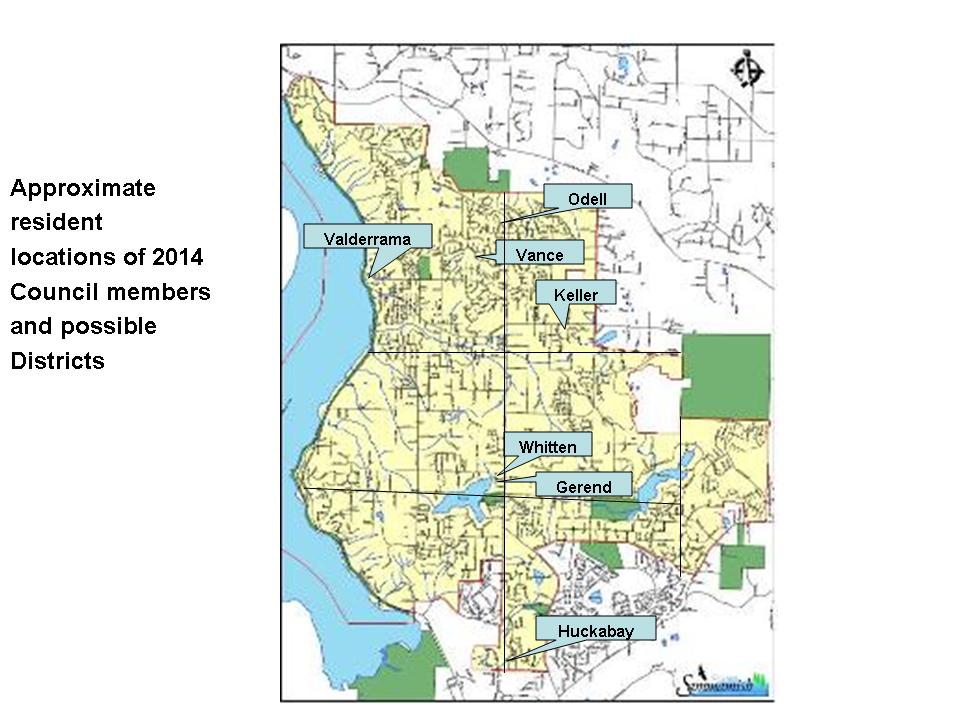
Throughout the history of the City, the council seats have pretty much been concentrated along the center of the City. Councilman Phil Dyer, who served one term from 1999-2001, lived by the lake and so does today’s Ramiro Valderrama. But the rest of the council members are from the Plateau.

I’ve put together this map showing the approximate locations where the new City Council members reside. As you can see, the concentration is still on the Plateau.The locations aren’t precise because the map from the Internet was poor quality and I couldn’t see the street names, so pardon if some of the residences are a little off–but they are close enough for to illustrate the point.

I’ve drawn in possible district lines, based solely on geography and not on population proportions (which is how they have to be drawn). Click on the map to enlarge.

CityCouncilLocations

I’m taking no position on whether continuing the at-large elections or creating districts is the preferred choice. It’s just food for thought. Maybe this is something for Citizens for Sammamish to study.

Last minute EF&R breakthrough keeps Sammamish in, pending approval

A last minute breakthrough in funding arrangement for the Eastside Fire and Rescue changed the recommendation from Ben Yacizi, city manager of Sammamish, from “get out” to “stay in.”

But Issaquah has to sign off on the funding agreement, as do other members of EF&R, and it ratified by January 17 or Sammamish could still bolt.

The Sammamish Review has an extensive write-up.

Attention turns to Sammamish tonight on EF&R issue

Sammamish City Manager Ben Yacizi is supposed to give his recommendation whether to leave the Eastside Fire and Rescue consortium tonight at the city council meeting. He is expected to endorse forming Sammamish’s own fire department.

But there is a new twist.

The Eastside Professional Fire Fighters last week offered to pay up to $10,000 for a professional mediator for Sammamish and Issaquah to resolve differences over the funding and other issues. Although EF&R is made up of five entities, Issaquah is the leader in opposing a funding change that Sammamish wants, in order to save our taxpayers $440,000 a year.

I’ve learned that EPFF has received some positive response from Issaquah to the prospect of a mediator, which was my suggestion to Sammamish at its council meeting last week, and which EPFF acted upon.

There is also some movement on the part of EF&R members to adjust the funding formula, which could render moot the need for a mediator or for Sammamish to leave EF&R.

What impact these developments will have on Yacizi’s recommendation remains to be seen. The City Council plans to make a decision November 12.

The fire issue is the last damn thing on the agenda tonight.

The Council meeting begins at 6:30pm and is televised on Comcast Channel 21. It is streamed live on the city website as well.

Issaquah issued this statement on Tuesday saying it wants Sammamish to stay in EF&R.