Why Issaquah can’t be trusted, Part 3: City reneged on signed MOU transferring Klahanie PAA to Sammamish

I’ve previously written Part 1 and Part 2 about why Issaquah can’t be trusted. Here’s another reason, Part 3: Issaquah reneged on a May 2002 Memorandum of Understanding (MOU) with the City of Sammamish that would have transferred the Klahanie Potential Annexation Area to Sammamish from Issaquah.

Mayor Ava Frisinger signed the MOU on May 6, 2002, attested to by Marcia Conon, the city clerk, and “Approved as to Form” by Wayne Tanaka, the city attorney.

Four months later, in September, Issaquah reneged.

This timeline is outlined in a submission by Sammamish to the Boundary Review Board, which is holding a public meeting tonight on Issaquah’s request to authorize an annexation vote in February.

************************************************************

The Boundary Review Board holds its public hearing Wednesday, September 18, 2013, at 7pm at the Holiday Inn in Issaquah.

************************************************************

Here is a download of the MOU: Klahanie MOU

The MOU’s reasons are clearly stated: with Sammamish, then a newly incorporated city, having better proximity and more contiguous boarders, among other reasons, Frisinger and Sammamish City Manager Ben Yacizi, who signed the MOU for Sammamish, agreed that Klahanie should go to Sammamish.

Why Klahanie annexation, water fight matter to Sammamish

This is the “Sammamish Comment.” So why am I spending so much time on a water fight between Issaquah and the Sammamish Plateau Water and Sewer District and the proposed annexation by Issaquah of Klahanie?

Because of the impacts on Sammamish, which could be profound.

The water fight and the annexation are the crescendo of long-running disputes between Sammamish and Issaquah, in which Issaquah has basically stiff-armed Sammamish at nearly every turn–most notably years-long efforts to adjust the financial contributions of the many partners in the Eastside Fire and Rescue (EFR) service.

Sammamish, by assessed value of the homes and land, pays the largest share into EFR. But Issaquah generates more calls. By Sammamish’s analysis, Issaquah should be paying about $500,000 a year more than it is based on the actual calls.

Issaquah refuses to adjust. Relations between Sammamish and Issaquah have reached a breaking point. Sammamish will decide soon whether to withdraw from EFR and form its own fire department or possibly even an alliance with Redmond.

Sammamish might close “Klahanie” fire station

Sammamish has warned that if Klahanie annexes to Issaquah, Station 83, more commonly known as the Klahanie fire station–which is owned by Sammamish and located at SE 32nd and Issaquah-Pine Lake Road–may be closed. Issaquah, according to our information from Sammamish, has already told our leaders it won’t buy the station.

This didn’t stop the Issaquah police chief from telling Klahanie residents that he could co-locate a police sub-station at the Klahanie fire station, a comment that came as a surprise to Sammamish officials.

Issaquah’s arrogance over EFR matters–and the continued unfair financial burden Sammamish taxpayers have because of Issaquah–is an issue unto itself but it’s also tied to the Klahanie annexation.

Continue reading

Water District vs Issaquah: video presentations tell the story

The debate is contentious. The Sammamish Plateau Water and Sewer District says Issaquah wants to inject contaminated water into an area where fecal coliform can infiltrate into an aquifer that provides up to 50% of the drinking water for the District, which serves 54,000 residents in Issaquah (including part of the Issaquah Highlands, all of Providence Point and Overdale), all of Klahanie and other parts of unincorporated King County and roughly three quarters of Sammamish.

Issaquah officials charge the Water District is resorting to scare tactics and its real “agenda” is “self-preservation” and to block the potential annexation by Issaquah of Klahanie. What’s noteworthy of Mayor Ava Frisinger’s approach on this is that by making allegations that the District has an “agenda” and personally attacking the president of the District, she’s avoiding the issues and the City is repeating tactics from 2008 when the Washington Department of Ecology forced (repeat, forced) Issaquah to shut down the so-called LRIG (Lower Reid Infiltration Gallery) in the first place.

Then, according to the press report at the time, Issaquah told Ecology:

They stated that the DOE relied on information supplied by the Sammamish Plateau Water & Sewer District, and said it was “riddled with factual errors,” and contains “inflammatory, incorrect and prejudicial statements masquerading as science and technical analysis.” They also call the monitoring program required by the DOE order “extensive, expensive, excessive, unreasonable and arbitrary.

Frisinger and her administration are following the same line of attack today.

Fortunately, you can see for yourself. Issaquah and the Water District each made presentations to the Sammamish City Council on the issue. Sammamish is trying to sort out facts and has heard from both sides. Issaquah heard the presentation from its own consultant, who also presented to Sammamish, but has so far not wanted to hear from the Water District. It’s clear Issaquah doesn’t give a damn about public opinion or scientific questions over the dispute and it’s equally clear it doesn’t want to hear from the Water District, which is why the District felt compelled to “go public” in the first place.

But you can watch the following videos:

Issaquah Presentation to Issaquah City Council (this was the same presentation given to the Sammamish City Council the same evening). This is 31 minutes.

Water District Presentation to Sammamish City Council on June 4. (Issaquah hasn’t invited the Water District to present to the City Council). Advance to 46:30 minutes for the hour-long presentation.

I think you will find a great deal of useful information that you can compare about who is more factual and more complete.

With respect to the allegation of “self-preservation,” Issaquah is attempting a hostile takeover of a small portion of the District that includes three wells (the ones using the aquifer at risk) in such a way that will dismember the infrastructure to the detriment of Sammamish residents, and those in unincorporated King County. 93% of the District lies outside Issaquah (using Issaquah’s own number) and Issaquah refuses to talk with the District or Sammamish in a way to resolve these issues and concerns. Instead, officials have made it clear that they are only interested in themselves, no matter the consequences to anyone else.

The threat to the water quality is why the Water District is putting up such a fight.
The case for another off-leash dog park in Sammamish

Sammamish needs another off-leash dog park. Here’s why and how it can be safe.

The Beaver Lake dog park is too small to be of real use. The dogs don’t have enough room to run and play. The “dog prisons” that exist there now compress the play and exercise areas, and the large breed area with its path can be traversed in five minutes. My Golden Retriever gets no exercise to speak of here.

As readers know, I advocated turning Big Rock Park into an off-leash park. There was a long comment posted why this should not be done: safety, potential harm to sensitive areas, etc.

The response is easy.

First, if people know it’s an off-leash dog park, problem solved. The conflict emerges with the assumption that it is not an off-leash park and some people nonetheless let their dog off-leash.

Certain days (or even certain hours) could also be designated off-leash with the remaining days on-leash.

Second, as with Marymoor Park, fence off those sensitive areas. Costly? Perhaps, but after spending a half million dollars (!!!) for two (!!!) boat docks at Sammamish Landing, I’m not sure there is a good argument on cost.

Whether Big Rock Park or another park becomes off-leash, Sammamish has plenty of “people” parks. Having a sizable off-leash park, well designated, is a convenience and an amenity.

People complain about having to drive off the Plateau for goods and services, and note that keeping people on the Plateau reduces traffic. The same argument can be made for this amenity.

I received this email from a reader.

Continue reading

Gerend wants Klahanie; Issaquah to meet with Klahanie May 22

Don Gerend declared once again that as a Sammamish City Council member, he wants to see Klahanie annex to Sammamish instead of Issaquah.

The area with 10,000 residents and a shopping center is, of course, in the Issaquah Potential Annexation Area. Issaquah officials met May 8 with a small group of residents at the Issaquah City Hall and has a meeting scheduled May 22 at Challenger Elementary School, 25200 SE Klahanie Blvd. at 7 p.m. to discuss possible annexation into Issaquah.

Gerend made the comment to a resident who lives in an unincorporated area between Klahanie and Sammamish and who doesn’t want to be part of Issaquah. The area is also in Issaquah’s PAA. The resident asked Sammamish to become involved, which can only be done if the areas are struck from the Issaquah PAA.

Gerend said that for 14 years (his entire time on the Sammamish City Council) he’s wanted to annex Klahanie.

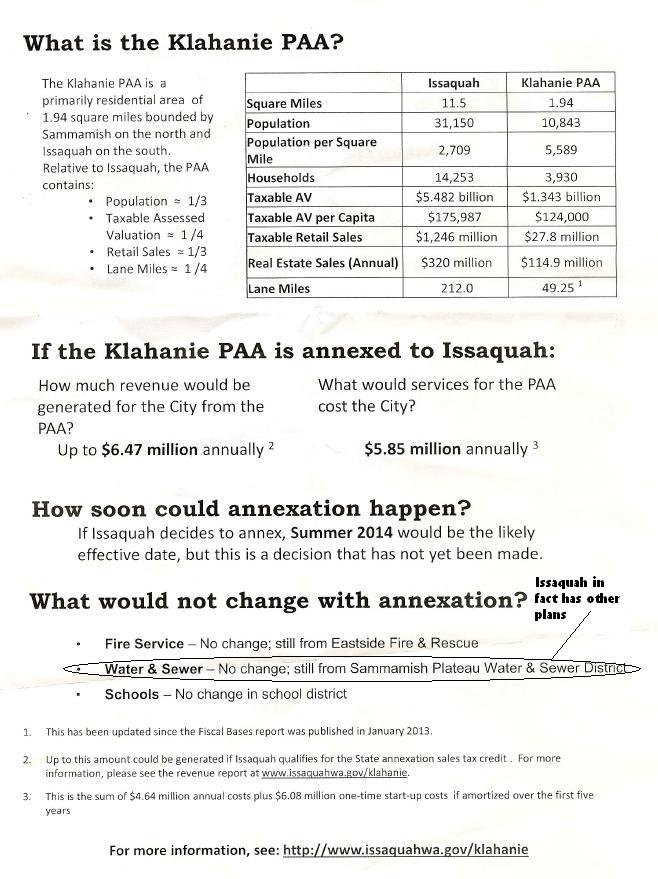
A complicating issue has emerged over annexing Klahanie, however: this is Issaquah’s permit application the State Department of Ecology to inject stormwater into the aquifer from which Klahanie gets its drinking water and plans to effect a hostile takeover of part of the Sammamish Plateau Water and Sewer District that draws its water from that aquifer.

Issaquah also eventually wants to assume the part of the Water District that Klahanie falls within, even though as recently as May 8 the city said nothing would change on this point, failing to reveal its true intentions.

I wrote about this deliberately misleading action on the part of Issaquah previously.

(Click on the illustration to enlarge.)

Klahanie SPWSD page

.

Clearly, Issaquah has some explaining to do with Klahanie, starting with why on May 8 it told Klahanie residents nothing would change about who provides water service to the area when plans have been underway for a long time to seek a hostile takeover of parts of the SPWSD, including the Klahanie area.

Then there are questions about the water quality protection of the aquifer that serves Klahanie. Although Issaquah claims its plan will be safe, the SPWSD has a different view. Klahanie residents might want to ask Issaquah and the Water District about this.

I have written several posts on this water topic. There are several links within the following to other stories by media. Here is a report from the Issaquah Press.

“We all drink from the same glass”

Issaquah takes the cheap route-except it doesn’t

Issaquah plan threatens Sammamish, Klahanie water supply